

1. The solidification process is extremely fast, and the production efficiency has doubled.
Ultra-fast curing is the most crucial and prominent advantage of UV light curing.
Traditional paints, adhesives and coatings dry and solidify mainly through the natural evaporation of solvents or through high-temperature baking. The entire process is very slow, often taking several minutes, several hours, and for some thick coatings, it may even take several days to completely dry. This greatly limits the production speed.
UV light curing completely breaks through this limitation. As long as the liquid material comes into contact with a specific intensity of ultraviolet radiation, the curing reaction will be triggered instantly, and the material will be completely hardened and set within a few seconds. On industrial production lines, after the workpiece is coated with glue and painted, it can immediately enter the next process after being exposed to UV light. The assembly line can operate continuously at high speed. For mass production and standardized production, this technology significantly shortens the production cycle, saving a lot of time costs and significantly increasing production capacity.
Compared with traditional solidification processes, UV light curing has significant advantages in terms of energy conservation and environmental protection, and is in line with the requirements of modern green production.
The traditional high-temperature baking and curing process requires the construction of large ovens and drying tunnels, which consume a large amount of electricity to generate high temperatures, resulting in extremely high energy loss. However, UV light curing does not require high-temperature heating. The entire equipment only uses UV lamps to consume electricity, significantly reducing the overall energy consumption and achieving very obvious energy-saving effects.
Meanwhile, the vast majority of UV-specific materials are solvent-free or have high solid content. During the curing process, almost no harmful organic solvents will volatilize. High-quality UV materials can even reach a solid content of over 97%. This not only reduces air pollution, improves the production environment in the workshop, but also avoids the harm to the operators' bodies caused by harmful gases. There is no need to deal with a large amount of waste solvents, effectively reducing the environmental protection pressure on the enterprise.
III. The finished product has excellent performance and is suitable for various scenarios.
Products formed by UV light curing have excellent physical and chemical properties and are extremely durable.
In terms of physical properties, the cured coating and gel have high hardness and are resistant to wear and scratches. The protective layer for mobile phone screens, the glossy finish of wooden furniture, and the wear-resistant surface layer of floors, all achieve high hardness and resistance to friction through UV curing. At the same time, the surface gloss after curing is uniform and bright, with a higher appearance quality and excellent decorative effect.
In terms of adaptability and corrosion resistance, UV glue and coatings have extremely strong adhesion to various materials such as metal, plastic, wood, and glass, and the bonding is firm and does not easily come off. Moreover, the finished product has excellent chemical resistance and can effectively resist daily oil stains and mild solvents, and can adapt to harsh usage environments such as humidity and mild corrosion for a long time.
4. Achieve stable and precise control, supporting precision processing
UV light curing has the characteristics of precise point curing and on-demand molding, with a much higher degree of accuracy than traditional processes.
The core feature of this technology is that only the areas exposed to ultraviolet light will solidify and take shape, while the unexposed areas will remain in a liquid state. Based on this characteristic, we can achieve precise local solidification by selectively blocking and precisely controlling the irradiation range of the light source.
This advantage is particularly crucial in the precision field: in the precision printing industry, it is possible to control the ink to only solidify in the pattern area, ensuring printing accuracy; in UV curing 3D printing, by layer-by-layer and point-by-point curing, complex three-dimensional models can be precisely shaped; in dental medicine, doctors can precisely control the position of ultraviolet radiation, allowing only the dental filling material to harden without damaging the healthy tissues around the mouth.
The traditional heat curing process requires the construction of extremely long high-temperature drying tunnels and large-scale drying equipment, which results in a large floor area and low utilization rate of the workshop space. The layout of the production line is also severely restricted.
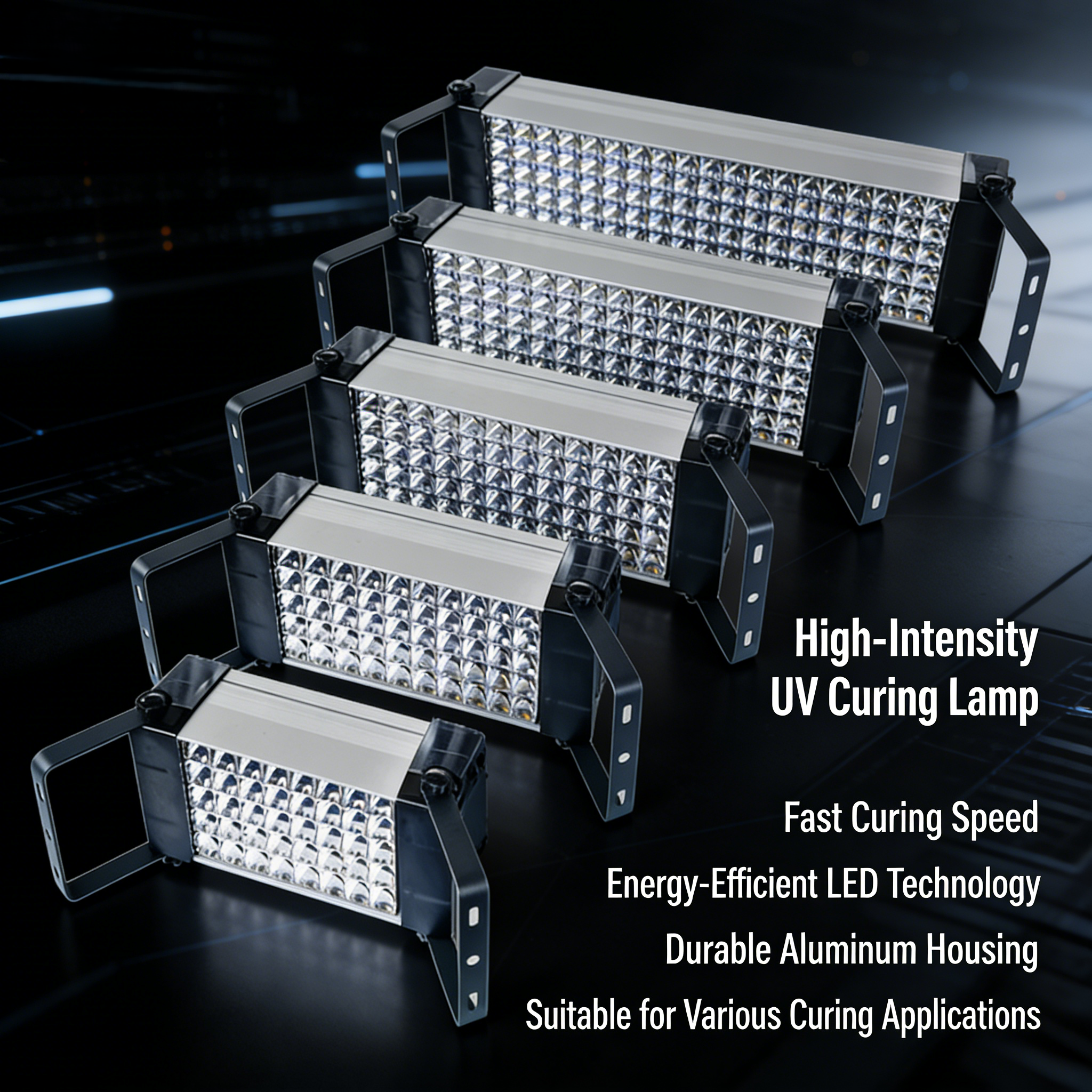
The UV light curing equipment has a compact structure and a small size. In industrial settings, only the UV lamp assembly needs to be fixedly installed, and combined with the conveyor belt, it can complete batch curing operations, significantly saving production site space. At the same time, the equipment is flexible in installation and can be adapted to various assembly line layouts, with extremely strong adaptability.
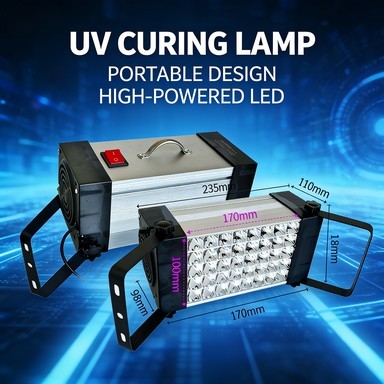
In addition, there is a portable handheld UV lamp that can be directly used for on-site construction, such as furniture touch-up painting, part bonding, and local repairs, etc. It does not require the assistance of large equipment and is extremely convenient to operate with high practicality.
Six. Widely applicable in various industries and fields
Thanks to its multiple core advantages, UV light curing technology has now permeated various industries and can be seen everywhere:
Printing and packaging: Magazine covers, gift box packaging, glossy coatings for printed products, and exquisite patterns are all formed through the rapid curing of UV inks, presenting bright colors and being resistant to color fading.
2. Electronic Components: The adhesive used for bonding the screen of mobile phones, the green coating for protecting circuit boards, and the protective coating for the outer layer of optical fibers all adopt UV curing technology, which is precise and stable.
3. Home Building Materials: Solid wood furniture, wooden flooring, and the wear-resistant glossy finish of cabinets, all of which are environmentally friendly, odorless, and highly durable;
4. Automotive Industry: Protective coatings for car headlight housings and interior decorative parts, resistant to wear and aging, enhancing the service life of the products;
5. Medical Cosmetics: Dental light-cured filling materials and nail curing gels are among the most common UV-curing applications in daily life.
6. Manual Manufacturing: In fields such as model making, figurine restoration, and artistic creation, UV-cured materials have a fast curing speed and excellent results, and are highly utilized.
VII. Technical Limitations and Usage Precautions
The UV light curing technology has significant advantages, but it is not perfect and has certain limitations in application:
The equipment has an investment cost: Special UV light source equipment needs to be equipped, and the initial investment in the equipment is higher than that of traditional processes.
2. Safety risks exist: Ultraviolet rays have certain harmful effects. During the operation, appropriate protective measures must be taken to prevent direct contact of the skin and eyes with ultraviolet radiation, and to avoid burns.
3. Limitations of the process: The ultraviolet rays have limited penetration ability and can only solidify transparent and light-colored thin-layer materials. The deep layers of opaque objects and materials cannot be solidified by this method, and dark and thick-layer materials are not suitable for this process.
4. High requirements for material storage: Most UV liquid materials are sensitive to light and will react prematurely under light exposure. Therefore, strict light avoidance is necessary during storage and operation.
Summary
Overall, UV light curing technology, with its core advantages of extremely fast speed, high efficiency, energy conservation and environmental friendliness, excellent performance, precise control, compact equipment, and wide adaptability, compensates for many shortcomings of traditional curing processes. Although there are a few usage limitations, with the continuous iteration of technology and the continuous reduction of equipment costs, the application scenarios of this technology are still continuously expanding, and it has become a core technology for modern precision manufacturing and green production, profoundly influencing industrial production and daily life.