

IR 2835 SMD LED: 730nm, 850nm and 940nm Applications
Infrared 2835 SMD LEDs are compact semiconductor light sources designed for specialized applications in horticultural lighting, night vision, optical sensing, and industrial equipment. Their small package size and compatibility with automated surface mount technology make them suitable for modern electronic and lighting products.
Among the available wavelengths, 730nm, 850nm, and 940nm serve different purposes. Understanding their optical characteristics, application requirements, and technical differences helps manufacturers select suitable LED components for reliable product performance.
1. What Is an IR 2835 SMD LED?
An IR 2835 SMD LED is a surface mount light emitting diode designed to produce radiation at a specific wavelength near or beyond the visible red spectrum.
The 2835 designation represents a nominal package size of 2.8mm by 3.5mm. This compact structure allows manufacturers to integrate infrared LEDs into PCB assemblies, lighting modules, and electronic devices.
Unlike conventional white LEDs, infrared LEDs are generally evaluated according to radiant power, peak wavelength, forward voltage, operating current, and radiation pattern.
Although these three wavelengths are sometimes grouped together in product catalogs, 730nm is classified as far-red light, while 850nm and 940nm are commonly used near-infrared wavelengths.
2. 730nm 2835 SMD LED for Horticultural Lighting
The 730nm 2835 SMD LED is primarily used in horticultural lighting systems, agricultural research, and specialized plant growth applications.
Far-red light interacts with the plant phytochrome system, which regulates important developmental processes. Depending on the plant species and lighting conditions, 730nm radiation can influence stem elongation, leaf expansion, and flowering responses.
Common applications include:
-
Horticultural LED grow lights
-
Greenhouse supplemental lighting
-
Indoor vertical farming systems
-
Plant growth research equipment
-
Customized agricultural lighting modules
In commercial horticultural lighting, 730nm LEDs are often combined with 660nm deep-red LEDs, blue LEDs, and full-spectrum lighting components.
The combination of different wavelengths allows lighting manufacturers to develop customized spectral solutions for specific crops and growing environments.
However, 730nm far-red light is generally used as a supplemental component rather than a complete standalone plant growth spectrum.
3. 850nm 2835 SMD LED for Night Vision and Infrared Imaging
The 850nm 2835 SMD LED is widely used in infrared illumination systems, particularly in security monitoring, industrial imaging, and optical detection equipment.
Many silicon-based camera sensors provide useful sensitivity at 850nm, allowing compatible cameras to capture images under low-light or dark conditions.
Typical applications include:
-
CCTV security cameras
-
Infrared night vision equipment
-
Industrial machine vision systems
-
Automated inspection equipment
-
Optical monitoring devices
One important characteristic of 850nm LEDs is that a faint red glow may be visible when viewing the emitter directly, particularly in dark environments.
Despite this characteristic, 850nm remains a practical wavelength for many infrared imaging systems because of its compatibility with commonly used image sensors.
For manufacturers developing night vision cameras or industrial inspection equipment, 850nm LEDs can provide an effective infrared illumination solution when combined with appropriate optical components.
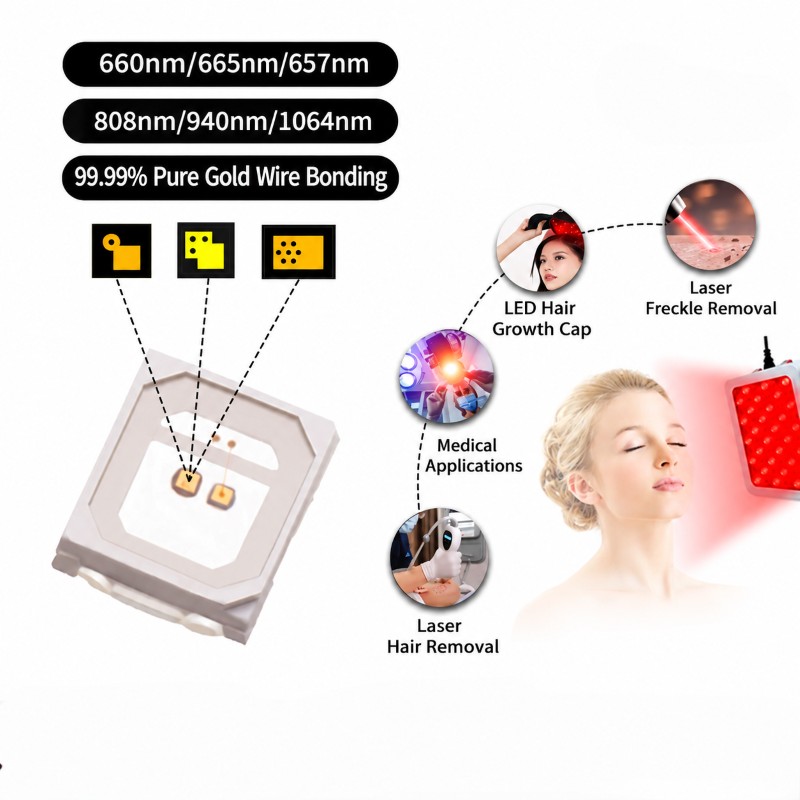
4. 940nm 2835 SMD LED for Optical Sensing
The 940nm 2835 SMD LED is commonly used in electronic sensing equipment, proximity detection systems, and infrared illumination applications where reduced visible red glow is desirable.
Compared with 850nm LEDs, 940nm emitters generally produce less noticeable visible light during operation.
Common applications include:
-
Infrared proximity sensors
-
Optical detection modules
-
Smart electronic appliances
-
Biometric recognition equipment
-
Automotive interior monitoring systems
-
Discreet infrared illumination
In reflective sensing applications, 940nm LEDs emit infrared radiation toward an object. A compatible receiver detects part of the reflected radiation to determine the presence or proximity of the target.
However, many silicon image sensors have lower sensitivity at 940nm compared with 850nm. Consequently, system designers must evaluate radiant output, receiver sensitivity, and optical requirements when selecting this wavelength.
For compact electronic devices and optical sensors, the 2835 package provides flexibility in PCB design and component integration.
5. Comparison of 730nm, 850nm and 940nm LEDs
Although these wavelengths share similar packaging options, their application characteristics differ considerably.
|
Parameter |
730nm |
850nm |
940nm |
|---|---|---|---|
|
Spectral region |
Far-red |
Near-infrared |
Near-infrared |
|
Main application |
Horticulture |
Night vision |
Optical sensing |
|
Visible emission |
Near visible red |
Faint red glow possible |
Minimal visible glow |
|
Camera illumination |
Specialized |
Common |
Common |
|
Plant lighting |
Yes |
Not typical |
Not typical |
|
Proximity detection |
Specialized |
Suitable |
Suitable |
The appropriate wavelength depends on the intended application rather than package dimensions alone.
For plant lighting, 730nm provides far-red radiation associated with plant development.
For infrared cameras, 850nm often offers favorable compatibility with silicon image sensors.
For applications requiring reduced visible emitter glow, 940nm may be the preferred option.
6. How to Choose the Right IR 2835 SMD LED
Selecting an infrared LED requires evaluating several technical parameters to ensure compatibility with the intended equipment.
Peak Wavelength
The peak wavelength determines the spectral characteristics of the LED. Manufacturers should select 730nm, 850nm, or 940nm according to the required optical response.
Radiant Power
Infrared LED output is generally measured in milliwatts. Radiant power influences the optical energy available for illumination and sensing applications.
Comparisons should be made under equivalent operating conditions.
Forward Voltage and Operating Current
Forward voltage and forward current are important considerations when designing LED drivers and electronic circuits.
Operating conditions should follow the component datasheet to maintain stable performance.
Radiation Pattern
The radiation pattern determines how infrared energy is distributed.
Wide illumination patterns may be suitable for short-range applications, while concentrated optical designs may be appropriate for targeted illumination.
Thermal Management
Temperature affects LED electrical characteristics and radiant output. Appropriate PCB design and thermal dissipation help maintain consistent operation and long-term reliability.
Manufacturers should also evaluate applicable optical safety requirements, particularly for high-output infrared illumination systems.
7. Advantages of 2835 SMD LED Packaging
The 2835 SMD package offers several advantages for manufacturers developing infrared and far-red LED products.
Its compact dimensions support flexible PCB layouts and allow multiple emitters to be incorporated into limited installation spaces.
Compatibility with automated SMT processes makes the package practical for commercial electronic assembly.
The package also supports customized LED module designs with different wavelength arrangements and optical configurations.
However, optical performance depends on the specific LED chip, package construction, and operating conditions. Manufacturers should always review the relevant product specifications before finalizing a design.
8. IR 2835 SMD LED Solutions from TTLED
TTLED is an LED packaging manufacturer based in Shenzhen, China, supplying SMD LED components for lighting manufacturers, electronic equipment producers, and OEM projects.
Our 2835 SMD LED product portfolio supports various wavelength requirements, including specialized far-red and infrared applications.
With a focus on product quality, manufacturing consistency, and technical product selection, TTLED helps customers identify suitable LED components for their applications.
Whether developing horticultural lighting systems, infrared monitoring equipment, or optical sensing devices, selecting the correct wavelength and electrical specifications is essential for reliable performance.
For product specifications, wavelength availability, and customized LED requirements, contact TTLED.
Email: info@ttled.com
Website: www.ttled.com
Conclusion
IR 2835 SMD LEDs provide compact and flexible solutions for applications requiring far-red and near-infrared radiation.
The 730nm wavelength is primarily used for horticultural lighting, 850nm is widely applied in night vision and infrared imaging, while 940nm is commonly selected for optical sensing and discreet illumination.
Understanding these wavelength differences helps manufacturers optimize component selection, improve system compatibility, and develop reliable electronic and lighting products.
TTLED provides 2835 SMD LED solutions to support specialized lighting and electronic applications.