

How to Choose the Right Wavelength for 2835 SMD LED Applications
Choosing the right wavelength for a 2835 SMD LED is essential for achieving optimal lighting performance, energy efficiency, and application reliability. Different wavelengths produce different optical effects, making wavelength selection an important consideration for LED lighting manufacturers and electronic product designers.
The 2835 SMD LED package is widely used in general lighting, horticultural lighting, decorative lighting, infrared sensing, and specialized industrial applications.
Understanding the differences between visible light, ultraviolet, far-red, and infrared wavelengths helps manufacturers select suitable LED components for specific product requirements.
1. Understanding Wavelength in 2835 SMD LEDs
Wavelength describes the distance between successive peaks of a light wave and is typically measured in nanometers (nm).
In LED applications, wavelength determines the color of emitted light or its interaction with materials, plants, and optical sensors.
For narrowband LEDs, the dominant wavelength or peak wavelength is commonly used to characterize the emitted radiation.
Visible light generally covers approximately 380nm to 780nm, although the exact boundaries depend on the reference definition.
Wavelengths outside this range may fall within the ultraviolet or infrared regions.
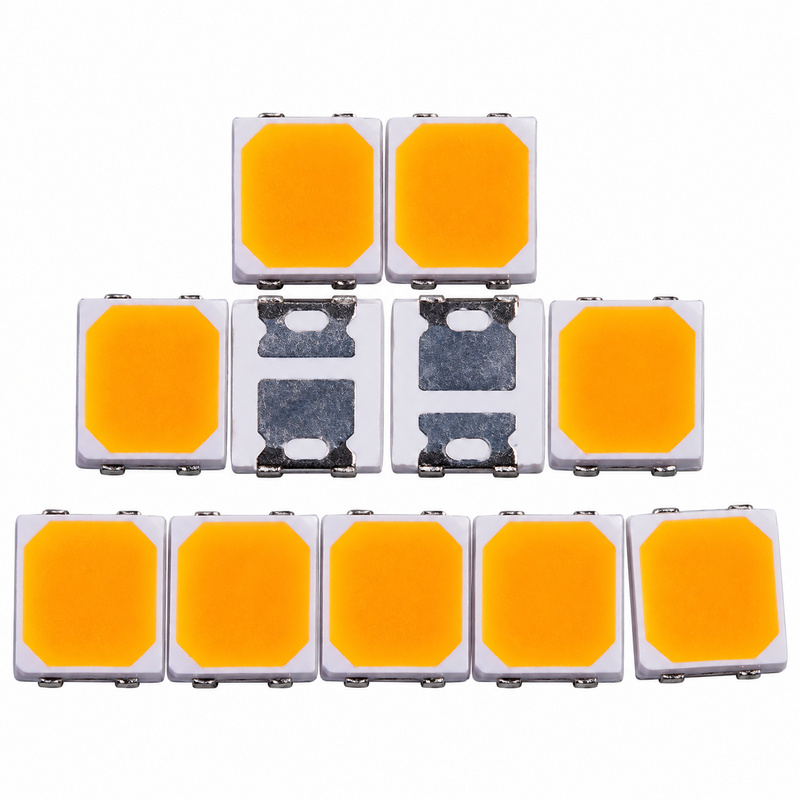
The 2835 package refers to nominal component dimensions of 2.8mm by 3.5mm. It does not determine the LED wavelength, optical output, or electrical characteristics.
2. Common Wavelength Options for 2835 SMD LEDs
Different 2835 SMD LED wavelengths serve different application requirements.
|
Wavelength |
Light Category |
Typical Applications |
|---|---|---|
|
365nm to 405nm |
UV and violet |
Curing, fluorescence, inspection |
|
450nm to 470nm |
Blue |
Plant lighting, decorative lighting |
|
520nm to 535nm |
Green |
Indicators, decorative lighting |
|
590nm to 610nm |
Amber and orange |
Indicators, signal lighting |
|
620nm to 630nm |
Red |
Decorative lighting, indicators |
|
660nm |
Deep red |
Horticultural lighting |
|
730nm |
Far-red |
Plant growth research, horticulture |
|
850nm |
Near-infrared |
Night vision, optical imaging |
|
940nm |
Near-infrared |
Proximity sensing, infrared detection |
These ranges are representative rather than universal product specifications. Actual wavelength availability and tolerance depend on the LED model.
3. Choosing UV 2835 SMD LEDs for Specialized Applications
Ultraviolet and violet 2835 SMD LEDs are used in applications requiring specific short-wavelength radiation.
Common wavelength options include 365nm, 385nm, 395nm, and 405nm.
365nm LEDs are frequently used for fluorescence excitation, specialized inspection, and compatible UV-curable materials.
385nm and 395nm LEDs are commonly used in UV curing systems, printing equipment, and industrial processing applications.
405nm LEDs are technically within the violet region of visible light under common spectral definitions, although they are often marketed alongside UV LED products.
When selecting UV LEDs, manufacturers should evaluate wavelength compatibility with the target material, radiant output, operating current, and thermal management.
UV curing performance depends on the absorption characteristics of the photoinitiator and the overall exposure conditions.
UV radiation can also present eye and skin hazards. Appropriate protective measures and applicable photobiological safety requirements should be considered during equipment design.
4. Selecting Visible Wavelengths for General and Decorative Lighting
Visible wavelength 2835 SMD LEDs are commonly used in lighting products that require specific colors or visual effects.
Blue LEDs, typically around 450nm to 470nm, are used in decorative illumination, indication systems, and horticultural lighting.
Green LEDs are suitable for signal indicators, display elements, and decorative lighting applications.
Amber, orange, and red LEDs are frequently used in warning indicators, architectural lighting, and color-specific illumination systems.
For white 2835 SMD LEDs, correlated color temperature (CCT) and color rendering index (CRI) are generally more useful selection parameters than a single peak wavelength.
White LED light is typically produced using a blue LED chip combined with phosphor materials, creating a broad output spectrum.
Manufacturers developing white lighting products should evaluate luminous efficacy, color consistency, CRI, CCT, and long-term performance.
5. Choosing 660nm 2835 SMD LEDs for Horticultural Lighting
The 660nm 2835 SMD LED produces deep-red light widely used in horticultural lighting systems.
Deep-red radiation is effectively absorbed by photosynthetic pigments and contributes to plant photosynthesis.
Typical applications include indoor farming, greenhouse supplemental lighting, vertical farming systems, and customized LED grow lights.
660nm LEDs are commonly combined with blue and broad-spectrum white LEDs to develop balanced plant lighting solutions.
When evaluating horticultural LEDs, manufacturers should consider photosynthetic photon flux (PPF), photosynthetic photon efficacy (PPE), spectral distribution, and the light requirements of the target crop.
Radiant power or luminous flux alone does not fully describe the suitability of an LED for plant growth applications.
The appropriate spectrum depends on plant species, growth stage, and environmental conditions.
6. Selecting 730nm Far-Red LEDs for Plant Development
The 730nm 2835 SMD LED is primarily used for far-red supplementation in horticultural lighting.
Far-red radiation interacts with the plant phytochrome system, which helps regulate flowering responses, stem elongation, and other developmental processes.
730nm LEDs are often combined with 660nm deep-red LEDs and broad-spectrum lighting components.
The balance between red and far-red light can influence plant morphology and growth responses.
However, excessive far-red radiation may produce undesirable elongation in certain crops.
Manufacturers should evaluate the complete lighting spectrum rather than selecting 730nm LEDs independently.
Far-red lighting is particularly relevant for controlled-environment agriculture and plant photobiology research.
7. Choosing 850nm and 940nm Infrared LEDs
Infrared 2835 SMD LEDs are commonly used in optical sensing, night vision, and electronic monitoring systems.
Two frequently selected wavelengths are 850nm and 940nm.
850nm Infrared LEDs
850nm LEDs are widely used in night vision cameras, security monitoring equipment, and industrial imaging systems.
Many silicon-based camera sensors provide useful sensitivity at 850nm, making this wavelength suitable for infrared illumination.
A faint red glow may be visible when viewing an 850nm emitter directly in darkness.
940nm Infrared LEDs
940nm LEDs are commonly used in proximity sensors, optical detection modules, and systems requiring reduced visible emitter glow.
Compared with 850nm LEDs, 940nm emitters generally produce less noticeable visible light.
However, many silicon image sensors have lower sensitivity at 940nm. Therefore, the selection should consider receiver compatibility, radiant output, and optical system requirements.
Neither wavelength is universally superior. The correct option depends on the intended sensing or imaging application.
8. Key Technical Factors When Selecting 2835 SMD LED Wavelengths
Wavelength selection is only one part of LED component evaluation. Manufacturers should also consider the following parameters.
Optical Output
Visible LEDs are commonly evaluated using luminous flux, while ultraviolet and infrared LEDs are generally specified by radiant power.
For horticultural lighting, photon-based measurements are particularly important.
Forward Voltage and Current
Different LED chip materials and wavelengths may require different forward voltages and operating currents.
Electrical specifications should be matched to the LED driver design.
Wavelength Tolerance
Wavelength variation can affect applications requiring precise optical characteristics, particularly fluorescence excitation, narrowband sensing, and specialized lighting.
Thermal Performance
LED operating temperature can influence optical output, efficiency, and long-term reliability.
Appropriate PCB design and thermal management are essential for stable operation.
Application Compatibility
Manufacturers should consider the complete optical system, including lenses, filters, sensors, target materials, and environmental conditions.
The selected LED wavelength should match the actual application requirements rather than relying only on nominal wavelength specifications.
9. 2835 SMD LED Solutions from TTLED
TTLED is a professional LED packaging manufacturer based in Shenzhen, China, supplying SMD LED components for lighting manufacturers, electronic equipment producers, and OEM projects.
Our 2835 SMD LED product portfolio supports a range of visible and specialized wavelength requirements for different lighting applications.
TTLED focuses on consistent product quality, manufacturing process control, and reliable LED component performance.
For manufacturers developing horticultural lighting, industrial equipment, decorative lighting, or optical sensing systems, choosing suitable wavelength and electrical specifications is essential.
Our team can assist customers with product selection according to application requirements and available technical specifications.
For wavelength availability, product datasheets, and customized LED requirements, contact TTLED.
Email: info@ttled.com
Website: www.ttled.com
Conclusion
Selecting the right wavelength for 2835 SMD LED applications requires understanding the relationship between optical characteristics and intended product functions.
UV and violet LEDs support curing and inspection applications, visible wavelengths provide color-specific illumination, 660nm and 730nm LEDs are important in horticultural lighting, and 850nm and 940nm LEDs are commonly used in infrared imaging and sensing.
By evaluating wavelength, optical output, electrical parameters, and operating conditions together, manufacturers can improve LED component selection and develop more reliable lighting and electronic products.
TTLED provides 2835 SMD LED solutions for manufacturers seeking consistent quality and application-specific wavelength options.