

Why 2835 SMD LED Has Become the Preferred Choice for Modern Lighting Products
The 2835 SMD LED has become one of the most widely used LED packages in modern lighting. It is commonly found in LED bulbs, panels, downlights, linear lighting, LED modules, and many other lighting products.
Its popularity is not simply because of its compact 2.8 × 3.5 mm package. The real advantage is its balance of luminous efficacy, optical performance, thermal characteristics, design flexibility, and manufacturing cost.
For lighting manufacturers, this combination makes the 2835 SMD LED a practical choice for both mass-produced and customized lighting products.
1. Compact Size, Flexible Lighting Design
The small 2835 package allows manufacturers to install LEDs at relatively high density on a PCB.
This provides greater flexibility when designing:
- LED panels
- Linear lights
- LED modules
- Thin lighting products
- High-uniformity light sources
By adjusting LED spacing and quantity, manufacturers can control light distribution and total luminous output more precisely.
This is particularly useful for applications where uniform illumination is more important than the output of each individual LED.
2. High Efficiency for Modern LED Lighting
Luminous efficacy, measured in lumens per watt (lm/W), is one of the most important performance indicators for modern lighting.
A well-designed 2835 SMD LED can provide high luminous efficacy while operating at an appropriate current, helping manufacturers achieve the required brightness without unnecessary power consumption.
However, the highest advertised lm/W is not always the best choice.
Actual efficiency depends on:
- Forward current
- Forward voltage
- CCT
- CRI
- Junction temperature
- LED chip and phosphor technology
Professional buyers should therefore compare LEDs under the same operating and test conditions, rather than comparing isolated headline specifications.
3. Good Balance Between Brightness and LED Density
The 2835 package gives designers flexibility to use more LEDs at lower individual power.
Instead of relying on a few high-power LEDs, a lighting product can use a larger number of 2835 SMD LEDs to distribute light more evenly.
This can provide:
- More uniform illumination
- Flexible LED spacing
- Better compatibility with diffusers
- Adjustable total luminous output
- Reduced optical concentration per LED
For LED panels and linear lighting, this design flexibility is particularly valuable.
The appropriate LED quantity and operating current depend on the required lumen output, PCB design, optical system, and thermal conditions.
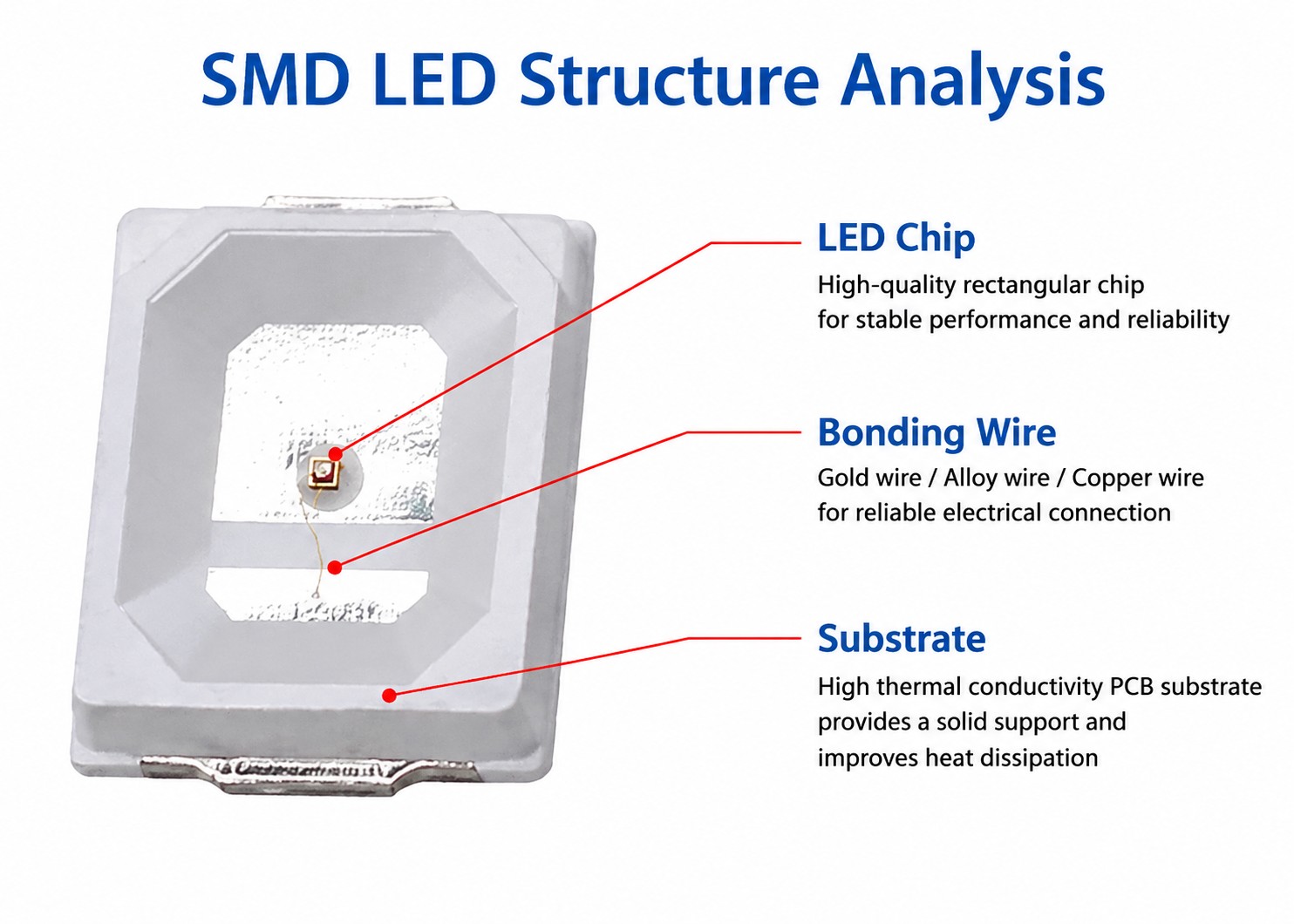
4. Thermal Performance and Reliability
Thermal management has a direct impact on LED reliability.
When an LED operates, electrical energy is partially converted into heat. Excessive junction temperature can accelerate lumen depreciation, color shift, and material degradation.
The thermal path includes:
LED junction → package → PCB → thermal interface → housing or heat sink → environment
Therefore, the performance of a 2835 SMD LED should always be considered together with the PCB and luminaire design.
Operating current is also important. Higher current can increase initial luminous output, but it also increases electrical power and thermal load.
For many lighting applications, the objective is to achieve the right balance between:
Brightness + efficiency + temperature + lifetime
5. Color Consistency and LED BIN Control
For professional lighting manufacturers, consistent color can be just as important as high luminous efficacy.
Large quantities of LEDs are often used in the same lighting product. If chromaticity varies significantly between LEDs or production batches, visible color differences may appear in finished products.
This is why LED BIN selection is important.
Key parameters can include:
- CCT
- CRI
- Chromaticity coordinates
- Luminous flux BIN
- Forward voltage BIN
Stable BIN control helps maintain consistency from:
LED → LED module → finished lighting product
This is especially important for LED panels, linear lighting, commercial lighting, and architectural applications.
6. Suitable for High-Volume SMT Production
The 2835 SMD LED is well suited to automated surface-mount assembly.
Its compact package can be efficiently integrated into standard PCB production processes, making it practical for high-volume manufacturing.
For manufacturers producing thousands or millions of units, production consistency becomes critical.
Stable performance in:
- Luminous flux
- Forward voltage
- CCT
- Chromaticity
- Electrical characteristics
can help reduce variation between production batches and improve finished-product quality.
7. Flexible for Different Lighting Applications
Another advantage of the 2835 platform is its flexibility.
Depending on the application, manufacturers can select different combinations of:
- CCT
- CRI
- Operating current
- Luminous flux
- Chromaticity BIN
- Chip configuration
For example:
Residential lighting may prioritize efficiency and cost.
Commercial lighting may require a balance of efficacy, CRI, consistency, and reliability.
High-CRI lighting may prioritize color rendering.
Linear lighting may place greater emphasis on color consistency and uniformity.
Therefore, there is no single “best” 2835 SMD LED. The correct specification depends on the final lighting product.
8. What Should Buyers Consider When Selecting a 2835 SMD LED?
Professional buyers should evaluate more than unit price or maximum lumen output.
Important parameters include:
| Parameter | Purpose |
|---|---|
| Luminous Flux | Optical output |
| lm/W | Energy efficiency |
| Forward Voltage | Electrical performance |
| Operating Current | Defines working condition |
| CCT | Light appearance |
| CRI | Color rendering |
| BIN | Color consistency |
| Thermal Characteristics | Reliability |
| Lumen Maintenance | Long-term performance |
| Test Conditions | Data comparability |
Batch-to-batch consistency should also be considered.
A good sample is not enough for mass production. The supplier should be able to reproduce stable optical and electrical performance across repeated orders.
Conclusion
The 2835 SMD LED has become a preferred choice for modern lighting because it offers a practical combination of compact size, high efficiency, flexible optical design, thermal performance, color consistency, and manufacturing compatibility.
Its biggest advantage is not one individual specification, but the balance between multiple requirements.
For lighting manufacturers, the right 2835 SMD LED should be selected according to the complete application:
Optical output → operating current → thermal conditions → color requirements → reliability → production consistency → total cost
When these factors are properly balanced, the 2835 SMD LED can provide a reliable and scalable light source for modern lighting products.
TTLED supplies 2835 SMD LED solutions for professional lighting applications, with options for different luminous flux, CCT, CRI, operating current, and BIN requirements. For OEM and customized lighting projects, selecting the LED according to the actual product requirements is essential for achieving stable performance and consistent production quality.