

Why LED Bin Selection Matters When Buying 2835 SMD LEDs
When buying 2835 SMD LEDs, many lighting manufacturers focus on luminous flux, efficacy, CCT, and unit price. However, one specification is often underestimated: LED BIN selection.
For small-volume applications, minor LED variations may not always be noticeable. But when thousands or millions of LEDs are used in the same lighting product, small differences in color, brightness, or electrical characteristics can become significant.
For professional lighting manufacturers, stable BIN selection is therefore not simply a technical detail. It is an important part of product consistency, quality control, and long-term production reliability.
1. What Is LED BIN Selection?
LED binning is the process of classifying LEDs into specific performance ranges according to measured characteristics.
Depending on the LED manufacturer and product, BIN information may cover:
- Luminous flux
- Forward voltage (Vf)
- CCT
- Chromaticity coordinates
- Other optical or electrical characteristics
For example, two 2835 SMD LEDs may both be specified as 3000K, but their actual chromaticity coordinates may be different.
Similarly, two LEDs with the same nominal power may have different forward voltage or luminous flux ranges.
BIN selection narrows these variations and allows lighting manufacturers to purchase LEDs with more predictable characteristics.
2. Why BIN Matters for 2835 SMD LEDs
A 2835 SMD LED is often used in relatively high quantities.
An LED panel, linear light, bulb, or module may contain dozens, hundreds, or even thousands of individual LEDs.
If the LEDs have significant variation, the differences can become visible in the finished product.
For example:
Uncontrolled variation → different LED characteristics → inconsistent light output or color → inconsistent finished products
By contrast:
Stable BIN selection → controlled LED characteristics → more consistent modules → more consistent lighting products
This is one of the main reasons professional manufacturers pay attention to BIN specifications rather than purchasing LEDs based only on nominal CCT or lumen output.
3. Color BIN Is Especially Important
For most white 2835 SMD LEDs, color consistency is one of the most important reasons to control BIN selection.
CCT describes the general appearance of white light, such as:
- 2700K
- 3000K
- 4000K
- 5000K
- 6500K
However, CCT alone does not completely describe the color of an LED.
Two LEDs can both be labeled 4000K while having slightly different chromaticity coordinates.
Under certain lighting conditions, these differences can become visible.
This is particularly important for:
- LED panels
- Linear lighting
- Commercial lighting
- Retail lighting
- Architectural lighting
- Large-area illuminated products
The larger the illuminated surface and the more LEDs used, the more important color consistency becomes.
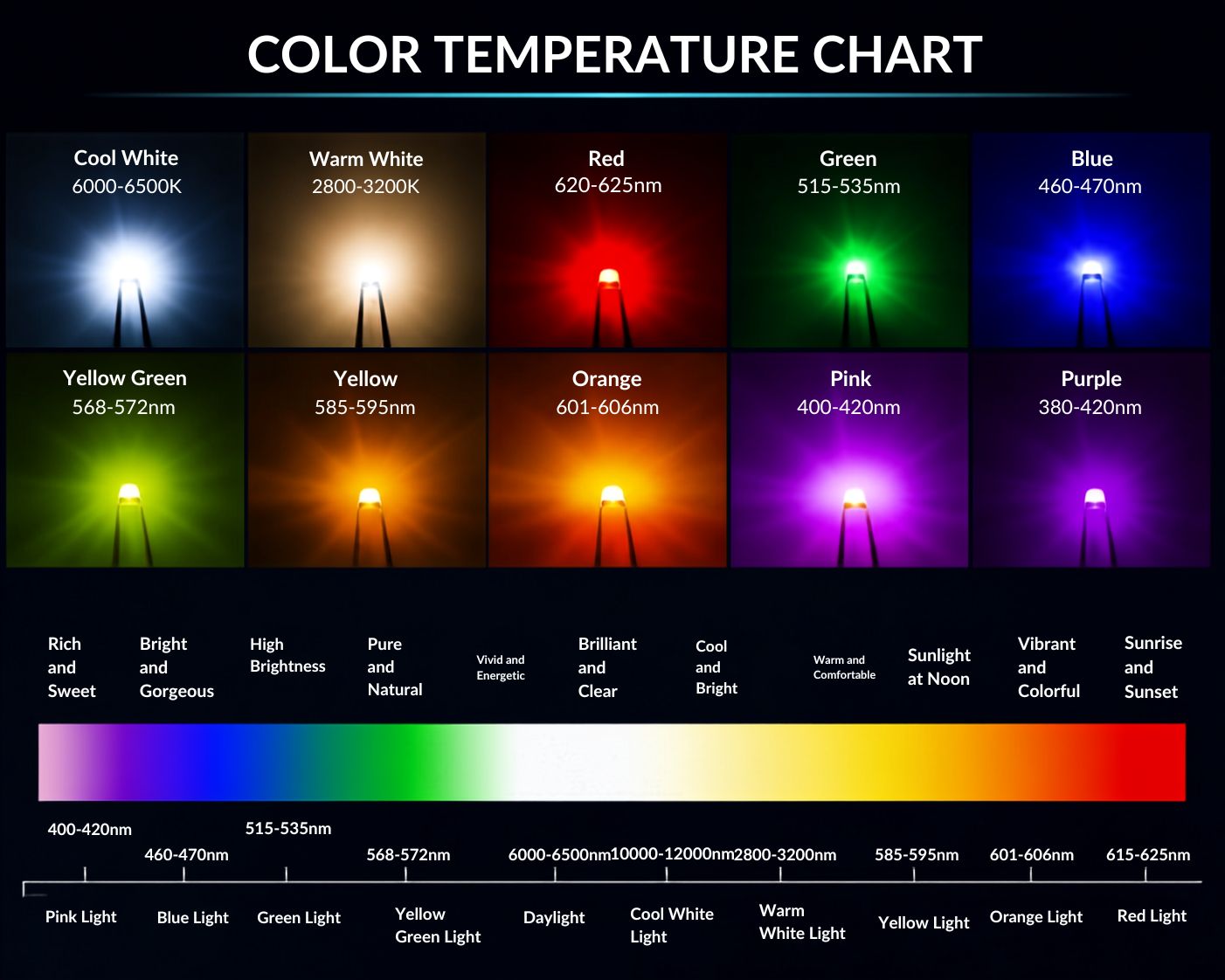
4. CCT Is Not the Same as Chromaticity
This distinction is important when evaluating 2835 SMD LEDs.
CCT describes the correlated color temperature of the light source.
Chromaticity coordinates provide a more precise description of where the light falls within the color space.
Therefore, specifying only:
4000K LED
may not provide sufficient control for a professional lighting project.
A more precise specification can include:
4000K + defined chromaticity range or BIN
This gives the manufacturer better control over LED-to-LED consistency and batch-to-batch color stability.
For projects where visual uniformity is important, chromaticity BIN selection can therefore be more meaningful than nominal CCT alone.
5. Luminous Flux BIN Also Affects Product Consistency
Color is not the only characteristic affected by binning.
Luminous flux BIN can help control differences in LED light output.
Imagine a lighting module containing many 2835 SMD LEDs. If some LEDs produce significantly more light than others, the module may show differences in local brightness or overall optical output.
Stable luminous flux BIN selection helps manufacturers achieve more predictable:
- Total lumen output
- LED-to-LED uniformity
- Module performance
- Finished-product specifications
This is particularly useful when the final lighting product has a defined lumen target.
Instead of compensating for large variations during production, manufacturers can start with LEDs within a controlled performance range.
6. Forward Voltage BIN Can Improve Electrical Consistency
Forward voltage, or Vf, is another parameter that may be controlled through LED binning.
Variation in Vf can affect the electrical characteristics of an LED array.
For products using large numbers of LEDs, consistent electrical characteristics can make system design and production control easier.
This can be relevant to:
- LED modules
- LED strips
- Linear lighting
- Large LED arrays
- High-volume lighting products
However, Vf BIN should always be evaluated according to the actual circuit and driver design.
The objective is not simply to select the lowest Vf, but to achieve a suitable and consistent electrical range for the application.
7. Why Batch-to-Batch Consistency Matters
One of the biggest concerns for lighting manufacturers is not whether one sample performs well.
It is whether the same performance can be maintained across repeated orders.
For example, a manufacturer may purchase 2835 SMD LEDs for a product that remains in production for several years.
If the supplier provides significantly different BIN characteristics in later batches, the finished products may show differences in:
- Color appearance
- Brightness
- Electrical performance
- Optical uniformity
This can create problems when products from different production periods are installed in the same project.
Therefore, a professional LED supplier should be able to provide stable and clearly defined BIN specifications across production batches.
8. BIN Selection Can Reduce Production Problems
Good BIN control can also simplify manufacturing.
When LED characteristics are more consistent, manufacturers can reduce the need for excessive sorting or adjustment during assembly.
This can improve control over:
- Incoming inspection
- Production yield
- Optical testing
- Finished-product consistency
- Quality control
For high-volume production, even small improvements in consistency can have a meaningful effect on manufacturing efficiency.
This is why BIN selection should be considered part of the overall supply-chain quality strategy, rather than simply a specification on an LED datasheet.
9. What Should Buyers Ask a 2835 SMD LED Supplier?
Before placing a large order, professional buyers should clarify the supplier's BIN information.
Useful questions include:
- What CCT range is available?
- What chromaticity BINs are available?
- What luminous flux BINs are available?
- What forward voltage range is specified?
- Are the same BIN specifications maintained for repeat orders?
- What are the test conditions for the stated specifications?
- Can production samples be provided for verification?
The test conditions are particularly important.
LED specifications should be compared under consistent conditions such as operating current, temperature, CCT, and measurement method.
Otherwise, two suppliers may appear to offer similar products while their actual performance is different.
10. How to Specify BIN Requirements in a Purchase
Instead of simply ordering:
“2835 SMD LED, 4000K”
a professional specification can be more detailed.
For example, a buyer may define requirements for:
Package: 2835 SMD LED
CCT: 4000K
CRI: ≥ specified level
Luminous flux: defined range
Chromaticity: specified BIN or tolerance
Forward voltage: defined range
Operating current: specified test condition
The exact BIN requirements should depend on the lighting application.
A commercial lighting manufacturer may require tighter color control than a basic consumer lighting product.
The objective is to specify enough information to ensure consistent product performance without unnecessarily increasing component cost.
Conclusion
When buying 2835 SMD LEDs, BIN selection should not be treated as a minor technical detail.
A properly controlled BIN can help manufacturers maintain consistency in:
- Color appearance
- Luminous flux
- Forward voltage
- LED-to-LED performance
- Batch-to-batch production
For professional lighting products, this consistency can directly affect finished-product quality and customer satisfaction.
The key principle is simple:
Stable BIN selection → stable LED performance → consistent lighting products.
When evaluating a 2835 SMD LED supplier, therefore, look beyond the nominal CCT, lumen rating, and unit price. Ask how the supplier controls BIN selection, production variation, and repeat-batch consistency.
For professional lighting manufacturers, the value of a 2835 SMD LED is not only its initial performance, but also its ability to deliver the same performance consistently throughout long-term production.
TTLED provides 2835 SMD LED solutions with controlled optical and electrical specifications for professional lighting applications. Depending on the project requirements, CCT, CRI, luminous flux, chromaticity BIN, and forward voltage can be specified to achieve more consistent LED and finished-product performance.