

2835 SMD LED Performance Guide: Efficiency, Brightness, Color Consistency and Reliability
The 2835 SMD LED has become one of the most widely used LED packages in modern lighting. Its compact size, optical performance, and flexible operating characteristics make it suitable for LED bulbs, panels, downlights, linear lighting, LED modules, and many other lighting products.
However, choosing a 2835 SMD LED should not be based on package size or luminous flux alone. Two LEDs using the same 2835 package can deliver significantly different performance in an actual lighting product.
For professional lighting manufacturers and LED buyers, the more important question is:
How efficiently, consistently, and reliably can the 2835 SMD LED maintain its performance under real operating conditions?
This guide examines four key factors: efficiency, brightness, color consistency, and reliability.
1. What Determines 2835 SMD LED Performance?
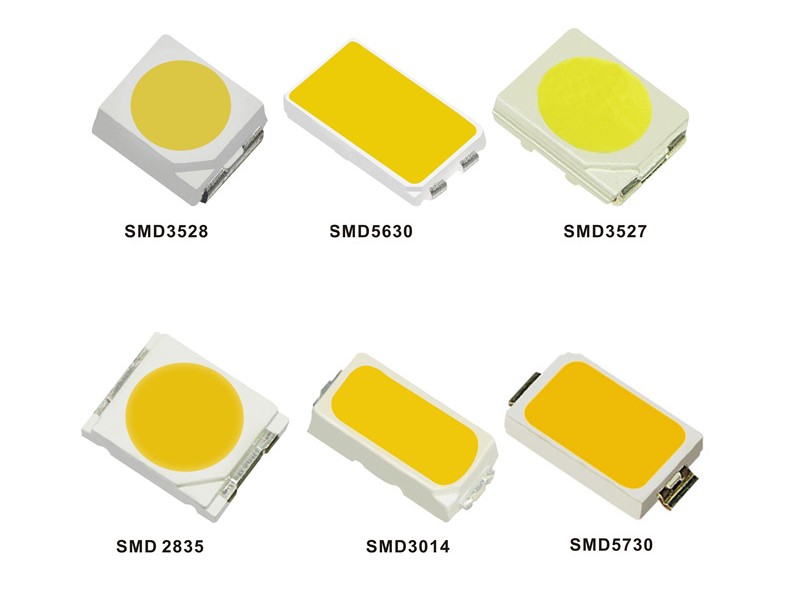
The designation 2835 primarily describes the package dimensions, approximately 2.8 × 3.5 mm. It does not define the LED's complete electrical or optical performance.
A 2835 SMD LED can be designed for different applications and performance levels. Important specifications include:
- Forward voltage (Vf)
- Forward current (If)
- Luminous flux
- Luminous efficacy
- CCT
- CRI
- Chromaticity and LED BIN
- Thermal characteristics
- Junction temperature
- Lumen maintenance
This means the package number should be considered a starting point rather than a complete performance specification.
For professional buyers, the LED should be evaluated as a complete optoelectronic component under clearly defined operating conditions.
2. Efficiency and Brightness: Look Beyond Lumens
LED efficiency is commonly measured by luminous efficacy, expressed in lumens per watt (lm/W).
The basic calculation is:
Luminous Efficacy = Luminous Flux ÷ Electrical Power
For example, an LED producing 30 lumens while consuming 0.2 W has an efficacy of 150 lm/W.
However, a higher lumen rating does not automatically mean a better 2835 SMD LED.
The actual performance depends on:
- Operating current
- Forward voltage
- Chip efficiency
- Optical extraction
- CCT and CRI
- Junction temperature
- Package and phosphor design
For example, one LED may produce more total lumens because it operates at a higher current, while another may achieve better lm/W at a lower power level.
Therefore, professional buyers should compare luminous flux and luminous efficacy at the same operating current, temperature, CCT, and test conditions.
Why operating current matters
Increasing LED current generally increases optical output, but it also increases electrical power and thermal load.
This creates a practical trade-off:
Higher current → higher initial output → higher power and heat → potentially greater long-term stress
For many lighting products, operating a 2835 SMD LED at an appropriate current can provide a better balance between efficiency, brightness, thermal performance, and lifetime than simply maximizing initial lumen output.
The best LED is therefore not necessarily the brightest LED. It is the LED that provides the required optical output at the appropriate operating point.
3. Color Consistency and LED BIN Selection
Color consistency is particularly important for lighting manufacturers producing large quantities of the same product.
A 2835 SMD LED's color characteristics are influenced by:
- Correlated color temperature (CCT)
- CRI
- Chromaticity coordinates
- Phosphor characteristics
- Manufacturing variation
Even relatively small differences between LEDs can become visible when hundreds of LEDs are installed in the same panel, linear light, or luminaire.
This is why LED BIN selection matters.
What is LED binning?
LED binning is the process of classifying LEDs according to defined performance ranges, such as luminous flux, forward voltage, and chromaticity.
Instead of simply purchasing a “6000K white LED,” a professional lighting manufacturer may specify a particular CCT range and chromaticity BIN.
This provides better control over color consistency between:
- Individual LEDs
- Production batches
- LED modules
- Finished lighting products
The basic production logic is:
Stable LED BIN → consistent LED output → consistent lighting products
For manufacturers supplying commercial, architectural, retail, or other visually sensitive lighting, stable BIN control can be as important as luminous efficacy.
4. Thermal Performance and Long-Term Reliability
Thermal management is one of the most important factors affecting LED reliability.
When an LED operates, part of the electrical energy is converted into heat. If this heat is not effectively dissipated, junction temperature increases.
Higher junction temperature can contribute to:
- Lumen depreciation
- Color shift
- Phosphor degradation
- Material aging
- Increased component stress
- Reduced long-term reliability
The thermal path extends through the complete lighting system:
LED junction → package → PCB → thermal interface → heat sink or housing → surrounding environment
Therefore, even a high-quality 2835 SMD LED requires appropriate PCB and luminaire thermal design.
Current and thermal stress
Operating an LED at excessive current can increase both optical output and thermal stress.
For this reason, lighting manufacturers need to balance:
Luminous output + efficacy + junction temperature + expected lifetime
A moderate operating current can sometimes provide better overall system performance than driving the LED at its maximum rated level.
5. Reliability Is More Than a Lifetime Number
LED datasheets may specify lifetime information such as L70, which generally refers to the time required for luminous output to decline to approximately 70% of its initial value under specified conditions.
However, a lifetime figure should always be evaluated together with its test conditions.
Actual LED reliability depends on factors including:
- Junction temperature
- Operating current
- Ambient temperature
- Thermal design
- Electrical stability
- Material quality
- Phosphor stability
- Encapsulation quality
- Manufacturing consistency
Therefore, a professional buyer should ask not only:
“What is the LED lifetime?”
but also:
“Under what operating conditions was this lifetime determined?”
A reliability specification without its operating conditions provides limited information for real-world product design.
6. Materials and Package Design Also Matter
The performance of a 2835 SMD LED is influenced by the materials and structures inside the package.
LED chip
The chip determines much of the LED's electrical and optical performance. Chip efficiency and manufacturing consistency directly affect the final component.
Phosphor
White LEDs use phosphor to convert part of the blue LED emission into longer-wavelength light. Phosphor characteristics influence CCT, CRI, luminous efficacy, and long-term color stability.
Encapsulation materials
Encapsulation materials protect internal components while allowing light to exit the package. Their optical and thermal stability can affect long-term performance.
Package structure
The package must provide an effective electrical and thermal pathway. Therefore, the external 2835 dimensions alone cannot tell buyers how an LED will perform.
7. How to Evaluate a 2835 SMD LED Supplier
For professional lighting manufacturers, comparing suppliers only by unit price or maximum lumen output is rarely sufficient.
A better approach is to request comparable technical data for:
| Parameter | Why It Matters |
|---|---|
| Forward Voltage (Vf) | Electrical power consumption |
| Forward Current (If) | Defines operating conditions |
| Luminous Flux | Total visible light output |
| Luminous Efficacy | Optical output per watt |
| CCT | White light appearance |
| CRI | Color rendering quality |
| Chromaticity BIN | Color consistency |
| Thermal Data | Heat management |
| Junction Temperature | Long-term reliability |
| Lumen Maintenance | Optical stability over time |
| Test Conditions | Makes supplier data comparable |
The most important point is:
Do not compare LED specifications unless the test conditions are comparable.
An LED tested at one current and temperature cannot be fairly compared with another LED tested under completely different conditions.
8. Batch-to-Batch Consistency Matters
A single sample can demonstrate excellent performance, but mass production introduces another important question:
Can the supplier reproduce the same performance consistently over time?
For lighting manufacturers, stable production is essential for controlling:
- Luminous flux
- Forward voltage
- CCT
- Chromaticity
- CRI
- Electrical characteristics
This is particularly important when the same lighting product is manufactured over multiple production runs.
Consistent LED production helps reduce variations in finished-product brightness and color appearance, making quality control more predictable.
Therefore, supplier evaluation should consider not only the datasheet but also production consistency and quality control capability.
9. Selecting the Right 2835 SMD LED for Different Applications
Different lighting products require different performance priorities.
LED Bulbs
Typical priorities include luminous efficacy, stable CCT, reliable operation, and thermal compatibility.
LED Panels
Color consistency becomes particularly important because differences in chromaticity can be easily visible across large illuminated surfaces.
Linear Lighting
Uniformity and stable BIN selection are important when many LEDs are installed along a long PCB.
Commercial Lighting
Efficiency, color quality, reliability, and production consistency may all be critical.
High-CRI Lighting
Color rendering becomes a higher priority, even if achieving higher CRI involves some reduction in luminous efficacy.
The right 2835 SMD LED should therefore be selected according to the requirements of the final lighting application.
10. A Practical 2835 SMD LED Evaluation Process
A professional selection process can follow several simple steps:
Step 1 — Define the application
Determine the required light output, CCT, CRI, operating environment, and expected lifetime.
Step 2 — Define the operating point
Specify the target current, voltage, and electrical power.
Step 3 — Compare optical performance
Compare luminous flux and lm/W under the same test conditions.
Step 4 — Control color
Specify CCT, CRI, and appropriate chromaticity BINs.
Step 5 — Evaluate thermal conditions
Consider the expected junction temperature in the actual lighting product.
Step 6 — Review reliability
Evaluate lumen maintenance and reliability data under defined operating conditions.
Step 7 — Validate production consistency
Test samples from different production batches rather than relying on a single sample.
This approach provides a more reliable basis for LED supplier selection than simply comparing price or maximum lumen output.
Conclusion
The performance of a 2835 SMD LED cannot be defined by package size or initial lumen output alone.
For professional lighting manufacturers, four factors deserve particular attention:
Efficiency determines how effectively electrical power is converted into useful light.
Brightness determines whether the LED can deliver the required optical output at the intended operating point.
Color consistency determines whether LEDs can maintain a uniform appearance across production batches and finished lighting products.
Reliability determines how effectively the LED maintains its optical and electrical performance over time.
The best 2835 SMD LED is therefore not necessarily the LED with the highest initial lumen output. It is the component that provides the right balance of efficiency, optical performance, color consistency, thermal behavior, and long-term reliability for the intended application.
For lighting manufacturers and LED importers, evaluating these factors together can help achieve more consistent production, more predictable product performance, and fewer quality issues in the field.
TTLED provides 2835 SMD LED solutions for professional lighting applications, with a focus on optical performance, LED BIN consistency, electrical characteristics, and production stability. For projects requiring specific CCT, CRI, current, luminous flux, or customized specifications, LED selection should begin with the actual requirements of the final lighting product.