

An UV
curing lamp is a device that uses ultraviolet radiation to cure coatings. It is
widely used in industrial production and research fields, and can improve
production efficiency and optimize product quality. This article will introduce
the principle of UV curing lamps in detail.
Firstly, let's understand the characteristics of ultraviolet rays. Ultraviolet rays are a type of electromagnetic wave with a short wavelength and high energy, thus having radiative properties. Ultraviolet rays can be divided into three regions: UVA, UVB, and UVC. Among them, UVC has the shortest wavelength and the highest energy, and has a strong sterilization and disinfection effect on living organisms and objects; UVB has a lower wavelength and moderate energy, and is applied in fluorescence detection and light-sensitive materials; UVA has the longest wavelength and weaker energy, and is commonly used for UV curing.
UV
curing is a process in which substances such as coatings and inks undergo
chemical reactions under the radiation of ultraviolet rays and quickly dry and
solidify. The main principle of UV curing lamps is to use the energy generated
by ultraviolet rays to excite the active substances in the curing agent,
causing them to react with the initiator in the coating, thereby achieving
rapid curing of the coating.
Specifically,
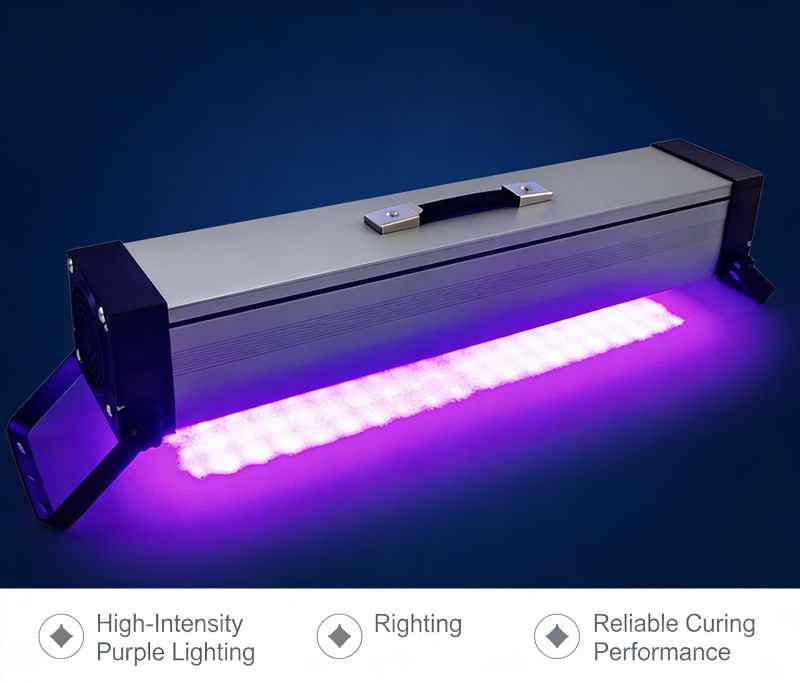
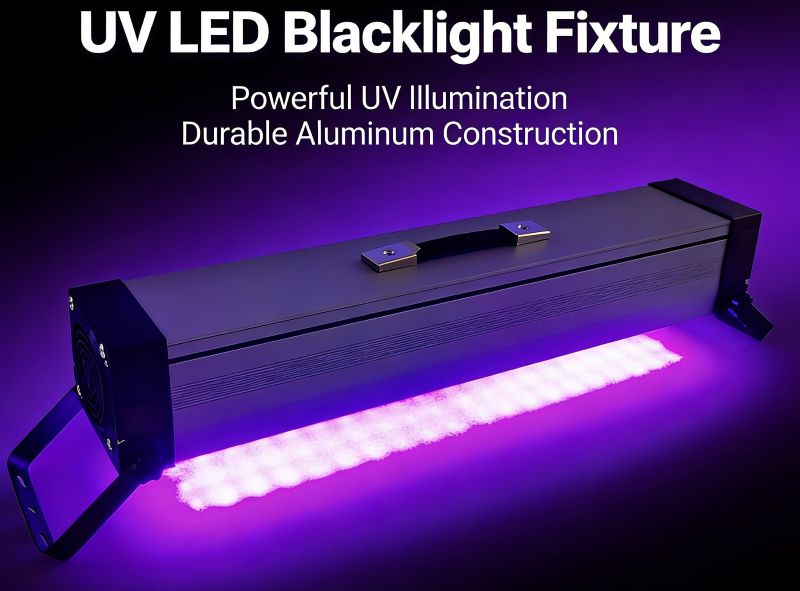
UV curing lamps are mainly composed of an ultraviolet lamp tube, reflectors,
conductors, and cooling devices. When the UV lamp tube is working, the
generated ultraviolet rays are reflected by the reflectors and focused onto the
coating surface, causing the initiator in the coating to react with the active
substances, initiating the chemical curing of the coating. The conductor plays
a role in evenly transmitting the illumination to the surface of the workpiece,
thereby achieving uniform curing of the entire coating.
The main
components of UV curing coatings include photosensitive initiators, monomers,
and auxiliaries. Photosensitive initiators are the key to UV curing. They
produce active substances under the action of ultraviolet rays and undergo
photochemical reactions with the monomers, causing the coating to rapidly cure.
Currently, commonly used photosensitive initiators include organic peroxides
and organic sulfides.
During
the curing reaction, the monomer is an important component of UV curing
coatings. The monomer molecule contains a large number of unsaturated groups,
such as double bonds and triple bonds, which, through the action of ultraviolet
rays and the initiator, form a cross-linked structure, causing the coating to
form a solid film. In addition, auxiliaries are also important components of UV
curing coatings. Auxiliaries can adjust the viscosity, consistency, and other
properties of the coating, thereby affecting the curing effect of the coating.
During
the UV curing process, it is necessary to pay attention to the requirements for
the object to be cured. Firstly, the object to be cured must have good light
transmittance to allow ultraviolet rays to pass through the surface of the
object and reach the coating surface; secondly, the surface of the object
should not have excessive dust and contaminants, as this may affect the
transmittance of ultraviolet rays. In addition, UV curing also requires
controlling the irradiation time, distance, energy, and other factors, as well
as the curing temperature of different coatings, to achieve the best curing
effect.
In
summary, the principle of UV curing lamps using ultraviolet radiation to cure
coatings is that the UV curing lamp tube generates ultraviolet rays, which are
then focused uniformly onto the coating surface by the reflectors and
conductors. The initiator in the coating reacts with the active substances,
initiating the chemical curing of the coating. Photosensitive initiators,
monomers, and auxiliaries in UV curing coatings also play important roles. In
practical applications, it is necessary to pay attention to the requirements
for the object to be cured and control the irradiation conditions to achieve
the best curing effect. The application of UV curing technology can not only
improve production efficiency but also reduce environmental pollution, and therefore
has broad prospects in the future development.